
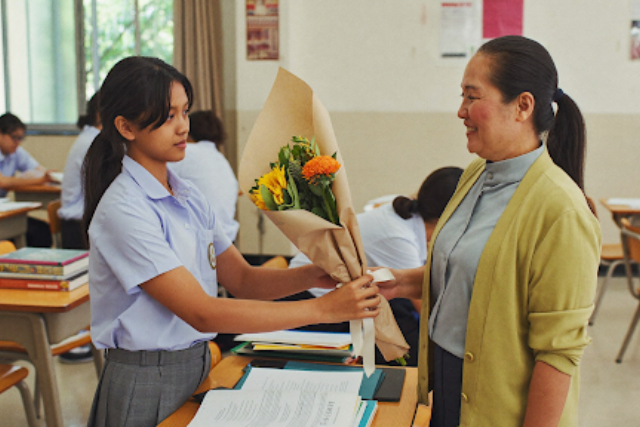
It is the week before Teacher’s Day and your child has just remembered they need something for their form teacher, or you are a student yourself trying to work out what actually says thank you without looking like you grabbed the first bunch at the checkout. Flowers seem like the obvious choice, until you start wondering whether roses read as too romantic for a teacher, whether a small bunch looks stingy, or whether anything will survive being carried around in a school bag until the last period. A parent messaging around a class chat group at ten at night, trying to work out whether everyone is pooling money or bringing something separately, knows the feeling just as well.
None of that has to be complicated. Teacher’s Day flowers work best when the choice is kept simple and genuine, and a handful of small decisions, colour, size, and timing, do most of the heavy lifting. This guide walks through those decisions so the gesture lands the way it is meant to.
Why Flowers Still Work for Teacher’s Day
A card says thank you in words, but a bouquet says it in a way that is hard to overlook on a desk full of marking. Teacher’s Day in Singapore has grown from a single school assembly into a genuine, if understated, tradition, and the Ministry of Education’s own Teacher’s Day celebrations mark it as one of the few moments in the school calendar set aside purely to recognise educators. Flowers fit that spirit well because they ask nothing in return. They are not a favour or an obligation, just a small, visible thank you. Unlike a gadget or a voucher, a bouquet also does not need to guess at a teacher’s personal taste beyond a colour or two, which is part of why it remains such a common choice year after year.
A Bit of Background
Teacher’s Day in Singapore is not a gazetted public holiday, but schools close for students and mark the occasion on the first Friday of September each year, usually with a concert or assembly organised by the students themselves. It grew out of a tradition of student-led appreciation that goes back decades, long before flowers or gifts became a common part of it.
That history is part of why the day still feels different from something like a birthday or a farewell. It was built around students choosing, on their own initiative, how to say thank you, which is roughly the same instinct behind picking out a bouquet today. Knowing that context does not change what to buy, but it explains why even a small gesture on the day tends to carry more weight than its size or price would suggest.
Getting the Colour Right
This is where most of the hesitation about buying teacher’s day flowers actually comes from, and it is a fair concern. Deep red roses in particular carry strong romantic associations, which makes them an easy colour to accidentally get wrong in a teacher-student context.
Yellow and orange blooms tend to be the safest starting point, since both read as friendship, warmth and gratitude, not romance. Sunflowers, chrysanthemums and yellow roses all fall into this territory, and a mixed bouquet that leans toward these tones with a little white or soft pink worked in usually reads as cheerful and appreciative without sending any unintended signal. Pastel pink carries a gentler, more platonic feel too, and pairs easily with yellow if you want a slightly fuller palette.
If a particular teacher has a known favourite flower or colour, it usually makes sense to follow that instinct instead of any general rule. A bouquet chosen with a specific person in mind, even an unconventional one, tends to feel more considered than a technically safe but generic arrangement.
White and green arrangements are another dependable option, particularly for a teacher whose taste you do not know well. A clean, mostly green and white bouquet reads as tasteful and considered in almost any setting, and it sidesteps the colour question entirely without looking like a compromise.
Choosing a Size That Fits the Setting
A staff room desk, a classroom shared with thirty other students’ gifts, and a teacher’s own commute home all shape what actually works as a Teacher’s Day bouquet. A handful of things are helpful to check before you order.
- A compact, well-held bouquet is usually easier for a teacher to manage on a bus or train than a large, loose armful.
- Sturdy stems and simple foliage hold up better after a day sitting in a warm classroom than delicate, thirsty blooms.
- A small posy or single-stem gesture is a perfectly complete gift on its own, not a lesser version of a bigger bouquet.
- Wrapping that closes securely does less for looks than for keeping petals from getting crushed in a bag.
None of this is about spending more. A modestly sized bouquet, chosen with these details in mind, tends to be appreciated more than a bigger one that wilts by the time the teacher gets it home. It also travels better through a school day that might involve a locker, a staff pigeonhole, and eventually a bus ride, so practicality and thoughtfulness end up pointing in the same direction.
Making a Modest Budget Look Generous
Students are usually working with pocket money, not a proper gift budget, and that is completely normal for this occasion. The good news is that how a bouquet is built shapes how full and considered it looks far more than how many stems are actually in it.
Foliage and filler are doing a lot of that work behind the scenes. Leafy greenery and smaller filler blooms bulk out the visual size of an arrangement around a few focal flowers, so a bouquet with three or four main stems can still look complete instead of sparse. It is a detail most people notice without ever quite knowing why, and it means a thoughtful, well-proportioned bouquet does not have to come with a large price tag attached. Wrapping plays a similar role, since simple kraft paper or a single ribbon in a complementary colour can make even a small posy look deliberately styled instead of thrown together at the last minute, and it costs next to nothing compared with adding more stems.
Group Gifts and Individual Gestures
Some classes pool money for one large bouquet from the whole form, while others prefer each student to bring something small of their own. Both approaches work, and neither is more meaningful than the other by default.
A single class bouquet tends to make more visual impact and avoids any awkwardness around who spent what, which suits classes that would rather organise one thing collectively. Individual gifts, even modest ones, give each student a personal moment of thanks that a shared card and bouquet cannot quite replicate, and many teachers say they remember those small individual gestures for years.
If your class is deciding between the two, it usually comes down to how comfortable everyone is coordinating money, not which option is inherently better. A middle option also works well: one class bouquet for a shared moment, alongside a few individual notes or small tokens from students who want to add something more personal. Whichever route a class takes, deciding early avoids the last-minute scramble to collect contributions the night before.
Getting It There on Time
Because Teacher’s Day tends to sneak up in the middle of a busy school week, timing is often the trickiest part of the whole gesture. Ordering a day or two ahead, with delivery to a home address the evening before, tends to be simpler than trying to coordinate a same-day drop-off around a school’s timetable. Bouquet.sg offers same-day and next-day delivery across Singapore, which gives some flexibility if the gift comes together at the last minute. Custom arrangement consultations are also an option if a class or a family wants something more specific put together, whether that is a particular colour scheme, a preferred flower, or a size suited to a bigger group gift.
A short handwritten note tucked into the bouquet, even just a line or two, often means more than the flowers alone. It puts a specific memory or thank you behind the gesture, which is usually what a teacher will remember longest after the blooms themselves have faded. Naming a specific lesson, a piece of advice, or a moment the teacher probably does not know was noticed tends to land better than a general thank you.
Frequently Asked Questions
Are red roses inappropriate for Teacher’s Day?
Red roses carry strong romantic associations in most contexts, so it is generally safer to choose yellow, orange or soft pink blooms that read as gratitude and warmth instead. A mixed bouquet that includes a few red blooms alongside other colours is usually fine, since it is the overall tone that a teacher notices, not any single stem.
How big should a Teacher’s Day bouquet be?
There is no minimum size that makes a gift appropriate. A small, well-arranged posy is a complete gesture on its own, especially for a student working with pocket money, and a considered small bouquet often makes more of an impression than a large one thrown together in a hurry.
Is it acceptable to give flowers instead of a physical gift?
Yes. Flowers are one of the most common and well-received Teacher’s Day gestures in Singapore, precisely because they feel personal without being extravagant, and they do not carry the same guesswork as trying to pick a gift a teacher might already own.
Should the whole class contribute to one bouquet, or should students give individually?
Either works well. A group bouquet is simple to coordinate and makes a strong visual impression, while individual gifts offer a more personal touch that some students prefer to give on their own.
Can I have flowers delivered directly to a school?
Delivery arrangements can vary by school, so it is often simpler to have the bouquet delivered to a home address the evening before Teacher’s Day instead of during school hours, then carried in the next morning.
What if I am ordering at the last minute?
Same-day and next-day delivery options can help if Teacher’s Day has crept up on you, though ordering a day or two ahead generally gives more choice over the arrangement itself and avoids any last-minute rush.
A Gesture That Does Not Need to Be Complicated
A good gift for a teacher keeps things simple: a considerate colour, a size that suits the setting, and a note that says specifically what you are thankful for. None of that requires a large budget or an elaborate arrangement, just a bit of thought put into a gesture that is already appreciated the moment it arrives. Whether it comes from one student or an entire class, that kind of thought tends to be remembered long after the actual blooms have gone. If you would like a hand choosing something suitable for a particular teacher, get in touch with our team and we can help put it together.